Rosa Müller · 15 October 2026
Nutrient Uptake Dynamics in Different Coral Morphotypes Within Variable Flow Regimes of Laboratory Microcosms
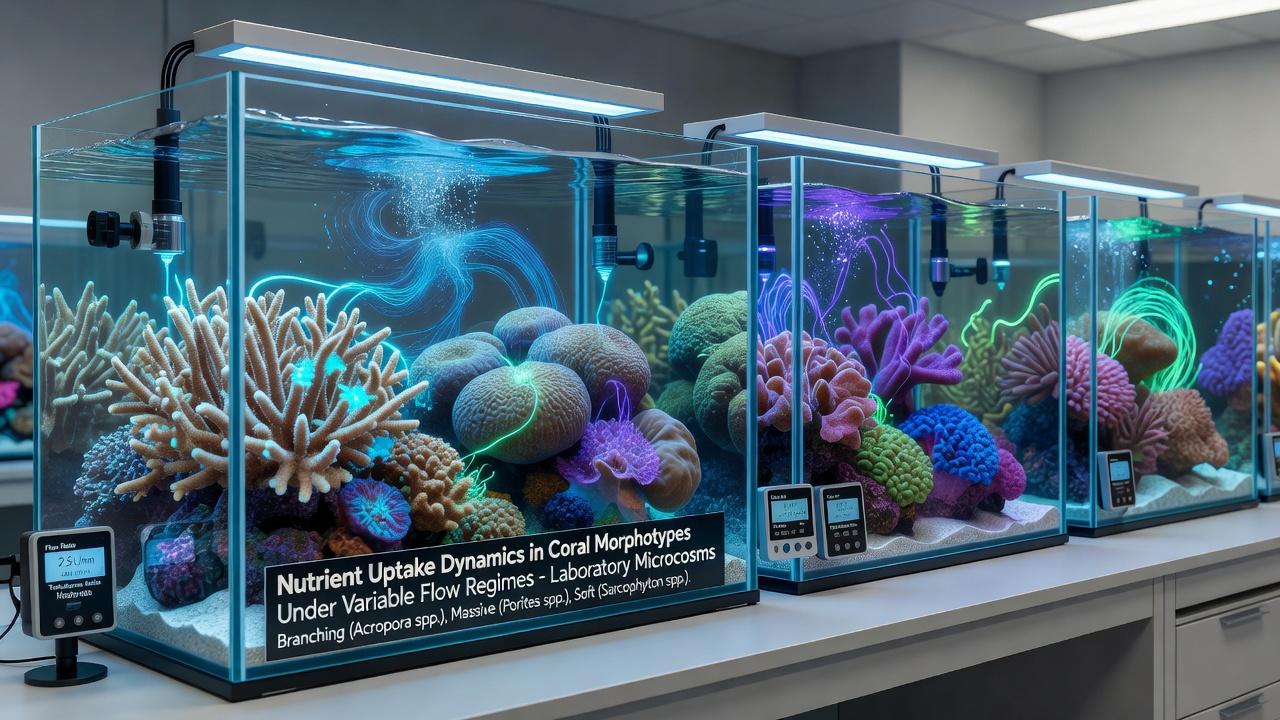
Nutrient uptake in corals depends on morphotype structure and the surrounding water movement patterns that researchers recreate inside laboratory microcosms, where branching forms such as Acropora often show higher surface area to volume ratios compared to massive or encrusting types that present flatter profiles and thicker boundary layers.
Coral Morphotypes and Their Structural Influence
Branching corals present intricate skeletons with numerous polyps distributed across extended surfaces, whereas massive corals develop compact shapes that limit exposed area yet provide stability under stronger currents, and these differences alter how dissolved nutrients like nitrate, ammonium, and phosphate reach the symbiotic algae living within coral tissues.
Researchers have documented that thinner branches create shorter diffusion distances for molecules moving from bulk water into the polyp layer, while encrusting morphotypes trap water in small depressions that slow exchange rates, and data collected across multiple tank trials reveal consistent patterns tied directly to these physical traits rather than species identity alone.
Flow Regimes in Controlled Microcosms
Variable flow conditions inside microcosms range from laminar streams at 5 centimeters per second to turbulent pulses exceeding 20 centimeters per second, and each regime changes the thickness of the diffusive boundary layer that sits against coral surfaces, thereby controlling the rate at which nutrients cross into living tissue.
Low flow allows nutrient gradients to build up near the coral, reducing uptake efficiency over time, yet moderate turbulence disrupts those gradients and delivers fresh supplies continuously, while high flow can sometimes strip away mucus layers that corals produce to capture particles, creating trade-offs that studies track through precise measurements of concentration changes in the surrounding water.
Measuring Uptake Across Morphotypes and Flows
Scientists set up replicated tanks holding fragments of different morphotypes under identical lighting and temperature, then introduce labeled nutrients and sample water at regular intervals to calculate depletion curves that indicate uptake kinetics, and these experiments show branching forms often achieve peak uptake at intermediate flows around 10 to 15 centimeters per second before rates plateau or decline at higher speeds.
Massive morphotypes maintain steadier uptake across a wider flow range because their lower surface complexity reduces sensitivity to boundary layer shifts, although overall capacity remains lower than branching types when total biomass is accounted for, and figures from repeated trials at facilities tracking these parameters confirm the interaction between shape and hydrodynamics as the dominant driver.
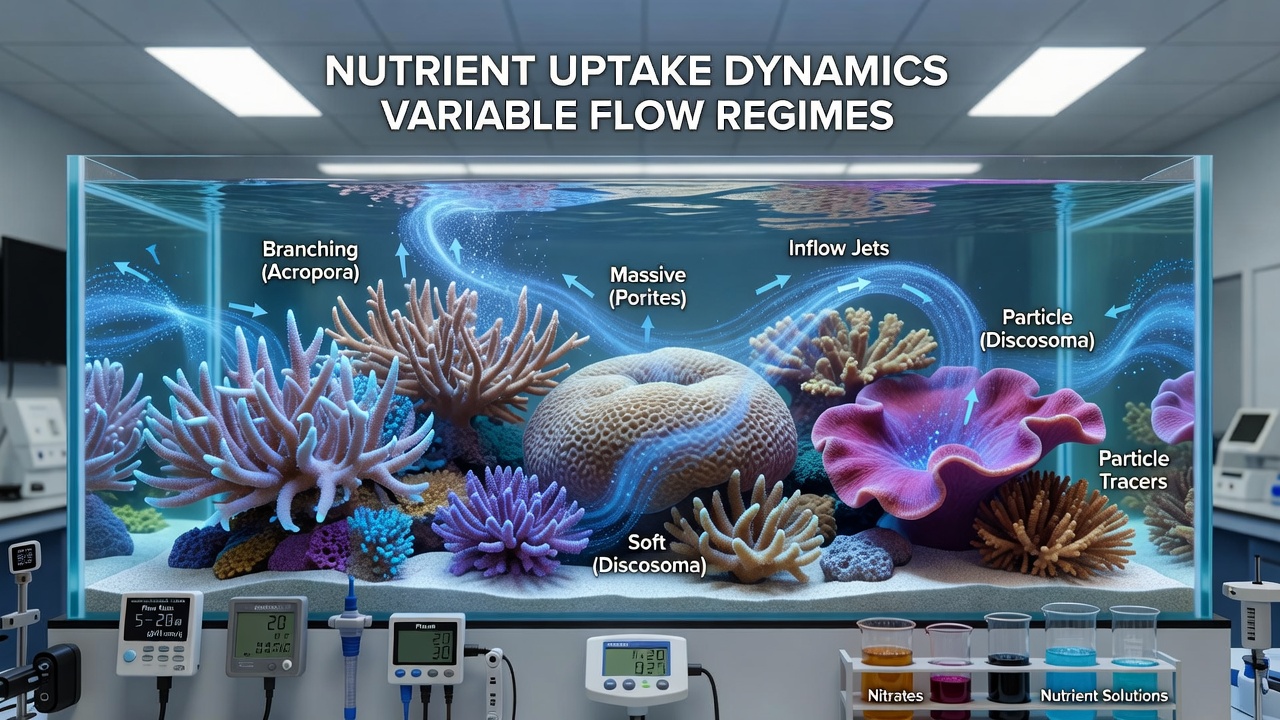
Additional work incorporates particle tracking and oxygen microelectrodes to map microscale flows around individual polyps, revealing how tentacle movement and ciliary action further modify local delivery of dissolved compounds, and such combined approaches highlight that uptake is never a simple function of concentration but emerges from the interplay of morphology, flow speed, and biological activity.
Key Variables Affecting Results
Temperature, light intensity, and prior feeding history all modulate the baseline metabolic demand that drives nutrient acquisition, while the presence of different symbiont clades alters how efficiently corals process incoming nitrogen or phosphorus once it crosses the boundary layer, and researchers standardize these factors across microcosm runs to isolate the effects of morphotype and flow.
According to findings shared by the National Oceanic and Atmospheric Administration, laboratory data align with field observations where flow variations on reefs produce similar spatial differences in coral health and growth rates, and parallel records from the Australian Institute of Marine Science reinforce that controlled microcosm results scale predictably when morphotype and flow parameters match natural conditions.
Conclusion
Collectively the evidence shows nutrient uptake emerges as a predictable outcome of coral shape interacting with water movement inside laboratory microcosms, and ongoing refinements in tank design continue to sharpen the resolution of these measurements for applications in restoration planning and climate response modeling.